
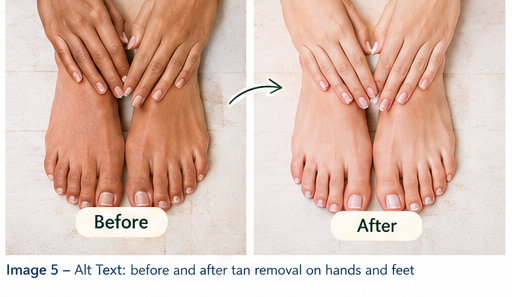

Have you noticed that your hands or feet look darker than the rest of your body after spending time outdoors?
You’re not alone. Hands and feet are among the most exposed parts of the body, yet many people remember to apply sunscreen to their face and forget about their hands, wrists, feet and ankles.
The result can be uneven skin tone, visible tan lines and darker-looking hands and feet.
The good news is that a tan can gradually fade as your skin naturally renews itself. The key is to combine sun protection, gentle skincare and consistency rather than relying on harsh scrubs or quick-fix remedies.
What Causes Tan on Hands and Feet?
A tan develops when the skin responds to ultraviolet radiation by increasing melanin production. This is why exposed areas can become darker after repeated sun exposure.
Hands and feet can be particularly noticeable because they are often exposed during:
- Walking outdoors
- Travelling
- Driving or riding a two-wheeler
- Shopping
- Daily commuting
- Outdoor sports
- Wearing sandals or open footwear
Another common problem is that people apply sunscreen to their face but forget their hands and feet.
How to Remove Tan From Hands and Feet
There isn’t a safe overnight method that can instantly erase a tan.
Instead, follow a simple routine.
1. Protect Your Hands and Feet From the Sun
Prevention is the most important part of tan care.
Apply a broad-spectrum sunscreen to exposed hands, wrists, feet and ankles whenever they will be exposed to the sun.
If you’re outdoors for an extended period, reapply according to the sunscreen’s directions.
You can also use physical protection such as:
- Full-sleeve clothing
- Gloves when appropriate
- Covered footwear
- Socks
- Shade or umbrellas
If you continue getting significant UV exposure without protection, your tan may continue to develop even while you’re treating uneven tone.
2. Exfoliate Gently
Gentle exfoliation can help remove dead surface skin and improve the appearance of uneven texture.
However, aggressive scrubbing isn’t the answer.
Avoid rubbing your hands or feet until the skin becomes red or irritated. Irritation can make pigmentation problems more difficult to manage.
Depending on your skin and the product, you might use a gentle chemical exfoliant occasionally rather than a rough physical scrub.
Start slowly and follow the product’s instructions.
3. Moisturize Your Hands and Feet
Don’t forget hydration.
Hands and feet can become dry from frequent washing, soaps, weather and environmental exposure.
Apply moisturizer after bathing and whenever your skin feels dry.
Ingredients commonly found in moisturizers include:
- Glycerin
- Ceramides
- Hyaluronic acid
- Panthenol
- Shea butter
- Squalane
Well-moisturized skin also tends to feel smoother and more comfortable.
4. Consider Brightening Ingredients
If uneven pigmentation remains after reducing sun exposure, skincare products containing certain brightening ingredients may help improve the appearance of uneven tone over time.
Ingredients you may see in body-care products include:
Niacinamide
Niacinamide is widely used in skincare and may help improve the appearance of uneven skin tone.
Alpha Arbutin
Alpha arbutin is another ingredient used in products designed to address the appearance of pigmentation.
Vitamin C
Vitamin C is commonly used in brightening skincare routines and antioxidant formulations.
The important thing is not to combine several strong products at once.
Introduce one product at a time and patch test when appropriate.
5. Don’t Forget Your Feet
Many people remember their hands but forget their feet.
If you regularly wear sandals or open shoes, your feet can receive plenty of sun exposure.
Apply sunscreen to exposed areas of your feet, including:
- Toes
- Tops of feet
- Ankles
- Exposed sides of feet
Pay special attention to areas where sandal straps create noticeable tan lines.
What About Home Remedies for Tan?
You’ll find many online recommendations involving lemon juice, baking soda, toothpaste and harsh scrubs.
Be careful.
Natural doesn’t automatically mean safe for your skin.
Ingredients such as lemon juice can irritate some people’s skin, particularly when combined with sun exposure.
Instead of trying a harsh DIY remedy, a gentle skincare routine is a more predictable approach.
How Long Does It Take for a Tan to Fade?
There isn’t one exact timeline.
It depends on:
- How much UV exposure you received
- How recently the tanning occurred
- Your natural skin pigmentation
- Whether you continue getting sun exposure
- Your skincare routine
- Whether the darkening is actually tanning or another pigmentation problem
Recent Indian skincare guidance on hands and feet suggests that consistent protection and gentle care may require several weeks rather than a few days to show visible changes.
So don’t judge your routine after three days.
Consistency matters more.
Simple Tan-Care Routine
Morning
Cleanse → Moisturize → Sunscreen
Evening
Cleanse → Gentle treatment if appropriate → Moisturize
Once or twice a week
Use a gentle exfoliating product if your skin tolerates it.
You don’t need to exfoliate every day.
5 Mistakes That Can Make Tan Care Worse
1. Scrubbing too hard
Aggressive scrubbing can irritate your skin.
2. Forgetting sunscreen
Without UV protection, you’re constantly adding new sun exposure.
3. Using too many brightening products
More products don’t necessarily mean faster results.
4. Using harsh DIY remedies
Lemon, baking soda and other irritating kitchen ingredients aren’t necessary for a good skincare routine.
5. Expecting overnight results
A tan doesn’t need to disappear in one day.
Give your skin time.
How to Prevent Tan on Hands and Feet
Prevention is easier than repeatedly trying to correct tanning.
Make these habits part of your routine:
- Apply sunscreen to exposed hands and feet
- Reapply when required
- Cover your skin when practical
- Avoid unnecessary prolonged sun exposure
- Moisturize regularly
- Don’t over-exfoliate
And remember: your hands need sunscreen too.
Frequently Asked Questions
Can I remove tan from my hands naturally?
A tan generally fades gradually as the skin renews itself. Protecting the skin from further UV exposure and maintaining a gentle skincare routine are more useful than aggressive DIY treatments.
Why are my hands darker than my face?
Hands are often exposed to sunlight while receiving less sunscreen and skincare than the face. Repeated UV exposure can therefore make the difference in tone more noticeable.
Can sunscreen prevent tanning?
Sunscreen helps protect exposed skin from UV radiation, but no sunscreen should be treated as an excuse for unlimited sun exposure. Use sunscreen as directed and combine it with shade and protective clothing when appropriate.
Can I exfoliate tanned hands every day?
Daily exfoliation isn’t necessary and may irritate your skin. Follow the instructions of the exfoliating product you use.
When should I see a dermatologist?
If pigmentation is persistent, rapidly changing, patchy, painful, itchy or doesn’t seem related to sun exposure, consider getting professional advice rather than assuming it is simply a tan.
Final Thoughts
If your hands and feet have become darker after spending time outdoors, don’t reach immediately for a harsh scrub.
Start with the basics:
Protect → Moisturize → Treat gently → Stay consistent.
With regular sun protection and a simple skincare routine, uneven tanning can gradually become less noticeable.
Your face isn’t the only part of your body that deserves sunscreen—your hands and feet need it too.